For years, Maria relied on seaweed farming to support her family. Today, she owns two boats, has renovated her home, and helps other farmers improve their livelihoods. Her story shows what can happen when small-scale producers gain direct access to skills, markets and commercial partnerships.
“As I recall, one of the major challenges we faced in developing this livelihood was the lack of sufficient funding”
When Maria first started, she had limited access to training on resilient seaweed farming practices, learning how to appropriately navigate weather conditions and how to face diseases like ice-ice that could inhibit seaweed production, often leading to the need to re-crop more seaweed propagules, without the ability to hire others for assistance.
However, her journey took a turn when Spanish NGO CODESPA, supported by the Julius Baer Foundation, connected seaweed farmers in Surigao del Sur with established seaweed processing company CEAMSA. The partnership provided farmers with training, technical support and financing, while creating more reliable market opportunities for their harvests. For producers like Maria, this meant greater access to buyers, fair prices and new opportunities to grow their livelihoods. Maria credits much of this progress to the training she received through the programme.
“Because of this kind of programme, CODESPA helps us to improve our skills by organizing seminars and trainings. They provided knowledge for us to adopt and have more resilient practices of planting seaweeds. And I thank God that he uses these people (CODESPA and government agencies) to help us enhance our traditional practice of planting seaweeds.”
Building on years of seaweed farming experience, Maria strengthened her production and now produces and sells both raw dried seaweed and fresh seaweed, creating additional sources of income for her family. The benefits of this growth have extended well beyond the farm.
Because of this kind of programme, CODESPA helps us to improve our skills by organizing seminars and trainings. They provided knowledge for us to adopt and have more resilient practices of planting seaweeds. And I thank God that he uses these people (CODESPA and government agencies) to help us enhance our traditional practice of planting seaweeds.
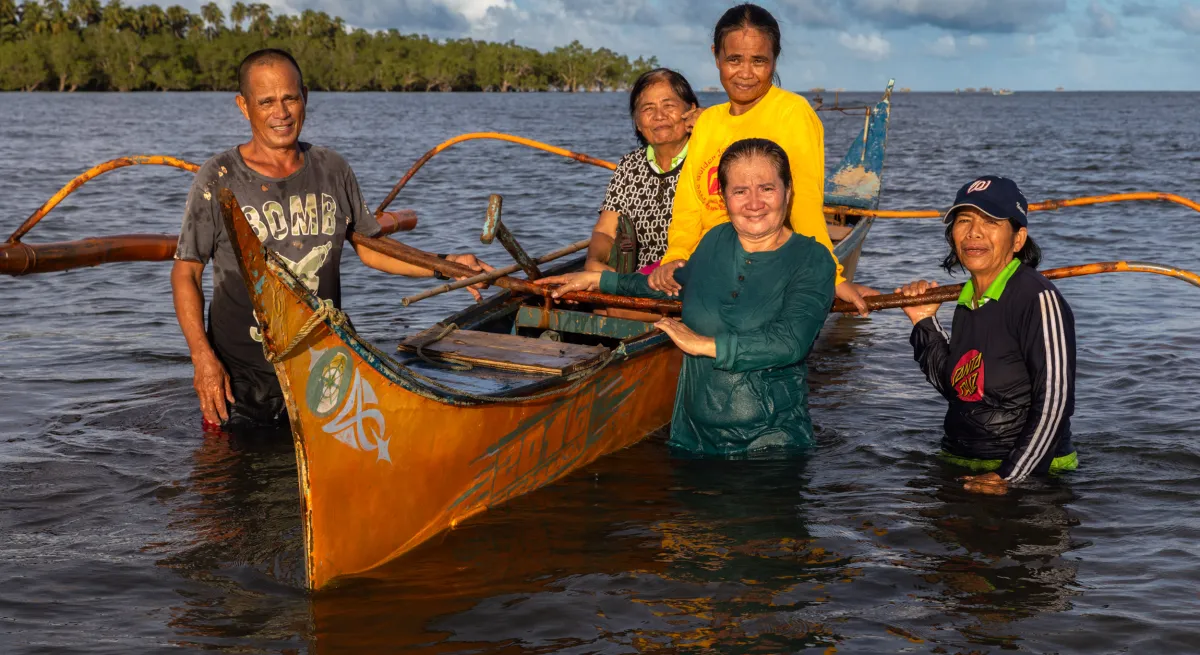
"What I am most proud of is that I am able to purchase supplies to renovate our house and I own two units of boats for transportation and planting purposes as this helps me also to transport my day-to-day activities and operation”
Beyond improving production, the programme helped Maria build valuable commercial relationships. New connections with buyers and fellow producers enabled her to expand her seaweed cultivation and grow her business.
“I made connections to some people (who) wanted to buy propagules from my cultured areas and this connection helped me to be able to produce more propagules, and I also encourage them to continue planting because no other livelihood we can rely on aside from this”
Beyond gaining access to new buyers, Maria also connected with other farmers, allowing her to learn new techniques and strengthen her seaweed farming practices. Today, she shares this knowledge with fellow farmers through her role as a Cluster 7 Leader of HISFACO.
Living in an island community, Maria mentions that she has seen first-hand challenges that come with living in a remote location. Government aid and support do not always reach them, making it difficult for families, like her own, to access the assistance needed. However, despite these obstacles, Maria has remained resilient and hopeful for an improved quality of life.
My hopes and dreams are for us seaweed farmers to gain more equal assistance from the agencies with capable of supporting seaweed farmers like us.
Today, Maria is not only a successful seaweed farmer, but also a respected leader within her community. The woman who once struggled to access funding, technical support and reliable markets now helps other farmers strengthen their livelihoods and navigate challenges of their own. As a Cluster Leader with HISFACO, she supports a group of local seaweed farmers, coordinating activities, sharing knowledge and helping improve the quality and productivity of their harvests. Through this role, she helps strengthen livelihoods across her community.
Maria’s story illustrates how stronger links between small-scale producers and established businesses can help create more equitable value chains. What began as support for one farmer has evolved into wider opportunities for families across her community.

Caroline Ross is an emerging global development professional with a passion for philanthropy, global health and social impact. She is currently an intern with the Julius Baer Foundation.
Prior to joining Julius Baer, she worked with non-profit organisations, including Full Court Peace, and contributed to a global health initiative focused on Malawi with the UNC Gillings School of Global Public Health. She also volunteers with Crisis Text Line.
Caroline holds a bachelor’s degree in Neuroscience from Hamilton College and is currently pursuing a master’s degree in Anthropology and Sociology of Development at the Geneva Graduate Institute.