The Simunye project was presented by Saadiq Chotia, project manager at Christel House South Africa at the Social Capital Conference 2026.
The Simunye Project (“We are one”) is a partnership between Christel House South Africa and the Julius Baer Foundation, developed to address persistent wealth inequality. Its core aim is to connect students from vastly different socio‑economic backgrounds, strengthening social capital and expanding access to opportunity.
The project was presented by Saadiq Chotia, Project Manager at Christel House South Africa, during a session on Social Capital and Mobility at the Social Capital Conference 2026.
Bridging divides
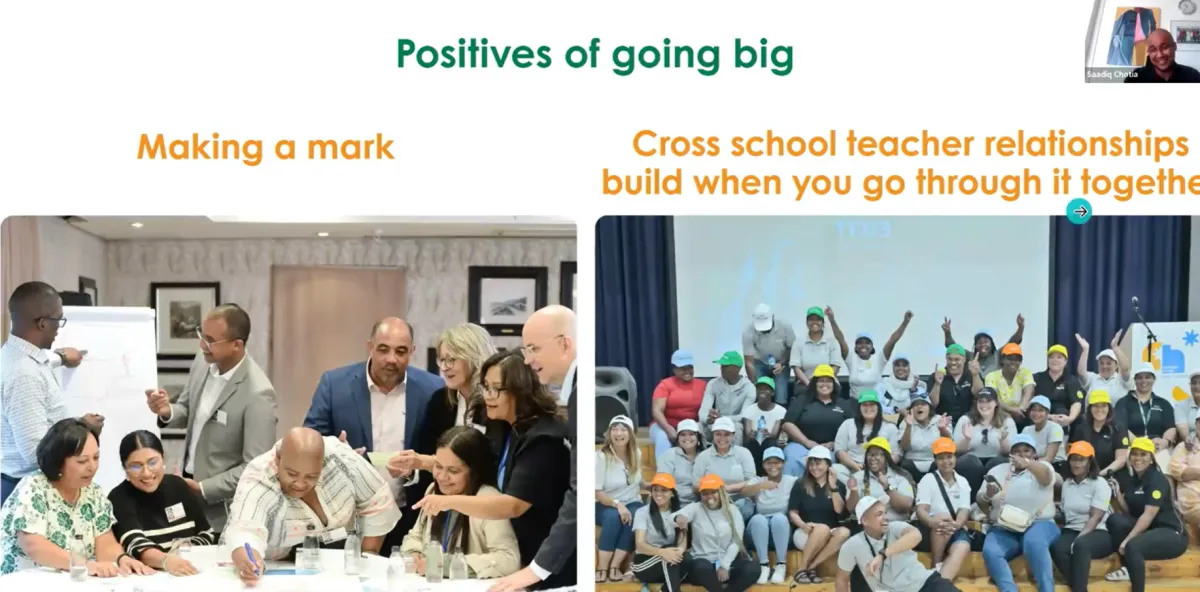
The Simunye Project currently connects 12 schools across a broad social spectrum, from well‑resourced institutions to schools serving underprivileged communities. Through exchanges, shared activities and immersive experiences, students are introduced to environments and perspectives they would not otherwise encounter.

The South African context: persistent inequality
As highlighted in the conference presentation, South Africa remains one of the most unequal countries globally, with a Gini coefficient of 0.67. Despite progress since the end of the Apartheid Regime in 1994, deep structural disparities continue to shape everyday life. In cities such as Cape Town, extreme wealth and entrenched poverty exist side by side.(1)
Youth unemployment remains particularly severe, with rates of around 60 per cent among those aged 18 to 24. In addition, approximately 42 per cent of young people grow up in households without an employed adult, significantly limiting their access to professional networks that are often critical to securing employment.(2)
In this context, social capital—the relationships and networks that open doors—becomes a decisive factor. As noted in the presentation, many first job opportunities arise through personal connections, which are frequently inaccessible to young people from disadvantaged backgrounds.
From exposure to meaningful connection
Since its inception, the Simunye Project has evolved in response to experience and learning. Early phases focused on large‑scale events involving hundreds of students. While these initiatives successfully built awareness and strong cross institutional relationships, they also revealed a clear limitation: student interactions tended to remain superficial.
In response, the project shifted towards a more intentional and immersive model, including:
- School rotations, where small groups of students visit partner schools and participate in everyday school life;
- Levelling activities, designed to reduce academic advantage and promote genuine collaboration;
- Structured reflection, enabling students to process their experiences and engage in thoughtful dialogue.
This revised approach has supported the development of deeper, more authentic relationships between participants.
Measurable impact
The impact of the Simunye Project is evident in both qualitative and quantitative outcomes:
- Over 82 per cent of students report increased confidence and improved social skills;
- Approximately 70 per cent have formed at least three new social connections, rising to 90 per cent among secondary school students;
- Many students maintain friendships beyond the programme, including during holidays and through digital platforms.
The benefits extend beyond students themselves. Teachers and schools increasingly share resources, support one another, and engage in collaborative networks that did not previously exist.
Engaging families and educators
One key lesson has been the importance of engaging families from the outset. Parent workshops have helped to:
- Gain the buy in of parents to continue the important conversations
- Build community in the programme;
- Establish a shared understanding of its purpose and objectives.
Mr Chotia also emphasised that teachers and school leaders play a central role in sustaining the project’s impact, as they nurture and maintain relationships over time.
Practising equity in every detail
Delivering an initiative of this nature demands continuous attention to equity. Decisions ranging from transport arrangements to activity design must be carefully considered to avoid reinforcing existing inequalities.
As noted in the presentation, achieving equity often requires questioning even the smallest details and reflecting critically on their broader implications.
Influencing the future of education
One of the project’s most significant developments is its potential influence on national education policy. The Simunye team has developed a proposed curriculum component on social capital, which could be implemented from Grade 4 through to Grade 12.
If realised, this would mark a meaningful step towards embedding connection, empathy and opportunity within the education system itself.
The Simunye Project demonstrates that meaningful connection across social divides does not happen by chance. It requires intentional design, sustained engagement and a deep commitment to equity. Ultimately, the initiative reinforces a powerful insight: addressing inequality is not only about redistributing resources, but also about expanding networks, relationships and the human connections that shape opportunity.
References:
(1) Department Statistics South Africa, Republic of South Africa. 2025. South Africa's Youth in the Labour Market: A Decade in Review. Statssa.gov. https://www.statssa.gov.za/?p=18398
(2)Ariane De Lannoy, Lauren Graham, Leila Patel & Murray Leibbrandt. 2018. What drives youth unemployment and what interventions help? A systematic overview of the evidence and a Theory of Change. High-level overview report, page 37
Learn more