Image

Johnny Miller's Unequal Scenes project has become one of the most recognisable visual explorations of inequality in the world. Through drone photography, he documents the physical boundaries separating people, nature, and their lives and stories.
In this conversation, Naveen Shamsudhin, Head of the Wealth Inequality Initiative, interviews artist and photographer Johnny Miller. Johnny reflects on the origins of the project, why returning to the United States changed his perspective on inequality, how aerial photography reveals realities hidden in plain sight, how photography can contribute to societal change, the responsibilities of artists, his emerging research collaborations and his vision of a more equal world.
Naveen: Johnny, what was the most unequal scene you have ever seen?
I started this project in a country that I wasn’t born in. So, for me, it was relatively easy to approach it with the eyes of an outsider. I was born in America, and I travelled to South Africa when I was 30 years old to be—essentially—a student at the University of Cape Town. That’s where the project began.
It started because I wanted to understand what the post-apartheid landscape looked like from above. At the time, drones were emerging as a new technology—accessible, affordable—and they gave me a way to explore urban inequality spatially and visually in a way that hadn’t been widely done before.
Now, when you ask what the real surprise was—what stood out as the most unequal scene—I have to say it wasn’t in South Africa. It was when I returned to the United States. It didn’t so much surprise me as it deeply saddened me. Because what I saw reinforced a broader truth: this isn’t just a South African problem, or a “Global South” problem. It’s systemic—present across geographies, cutting through the supposed divide between Global North and Global South, between rich and poor nations, developed and developing countries. Between my home country and my adopted one.
In 2017, I went back to Seattle—where I grew up, where I went to high school—to document the situation there. At the time, the city had introduced small, modular shelter units distributed throughout the city as a response to its escalating homelessness crisis. That crisis has only intensified since, particularly along the West Coast—in places like San Francisco, Los Angeles, and Skid Row.
But Seattle was different. It was personal. This was my city. And what struck me was how starkly those tiny shelters contrasted with the national mythos—a country built on opportunity, on the American Dream, on self-determination and the freedom to shape your life.
The shelters themselves were modest—maybe a couple of hundred square feet, similar in size to the informal dwellings I’d seen in Cape Town. Basic cabins, lined up in rows alongside noisy highways or tucked behind industrial estates—not exactly dignified or desirable places to live. And they weren’t even designed to last: the city mandated that they be relocated annually because permanence was politically unacceptable.
That pattern—the refusal to allow even humane, minimal solutions to become established—is something I’ve observed repeatedly in the U.S. People acknowledge the suffering. They see the failures in social care and housing provision. And yet, there remains a stubborn adherence to the very economic and political philosophies that enable those conditions to persist.
So there’s a disconnect—between what people say they value, what they’re willing to tolerate in their immediate environment, and what they ultimately support through policy and votes.
And it’s precisely in that gap—between belief and action, empathy and acceptance—that I hope my photographs begin to spark conversation. Not just about inequality, but about complicity, proximity, and what we’re collectively willing to change.

Did you experience a more visceral reaction witnessing these unequal scenes in the United States compared to what you've encountered elsewhere?
When I returned home and photographed cities such as Seattle, Oakland, Los Angeles, Baltimore, and Detroit, what I saw was a recurring homelessness crisis. I saw people living rough—tiny-home communities and DIY improvised solutions—attempting to address problems that governments had failed to resolve structurally.
This experience made the project much more personal.
People often ask me what poorer or disadvantaged communities think about my photographs. Are they shocked by the images?
My answer is always the same: when I show the photographs to people on both sides of the divide, it is almost always those on the more disadvantaged side who respond: “Yes, we know. We’ve been living like this for a long time.” The reaction of surprise usually comes from the affluent side.
When I show the photographs to people on both sides of the divide, it is almost always those on the more disadvantaged side who respond, "Yes, we know. We've been living like this for a long time." The reaction of surprise usually comes from the affluent side.
In many ways, that affluent audience has always been my primary audience. My goal is not simply to document poverty; it is to communicate the systemic nature of inequality to people who may not fully recognise it.
I love America—but one thing that interested me was the language often used when discussing countries outside the Global North. There is sometimes an implication that poverty or inequality are problems that belong elsewhere. Yet when you look at these places from the air, the similarities are striking.
You cannot easily distinguish between a tiny-home settlement in Seattle and an informal settlement in Cape Town. The photographs challenge the idea that these divisions are unique to any particular country—and force us to confront the systems that create them.
This isn’t a project about poverty. It isn’t a flyover of distant suffering designed to elicit sympathy. What I’m really trying to provoke is a sense of relevance—and perhaps, complicity.
Sometimes inequalities are everywhere, and they slowly become invisible. When you spoke about affluent communities not seeing them, was the invisibility coming from omnipresence, or were they completely ignorant?
That’s an interesting question. When the photos went viral in Cape Town, people were writing on my Facebook page saying:
“I never knew that inequality was this bad in South Africa.”
That, to me, was shocking. Because it was right there in front of everyone.
If you go back to Cape Town today, you still see the shacks extending for miles in every direction—hundreds of thousands of people living in really dire circumstances, while a tiny elite live in much more affluent, European-standard conditions along the coast and near the mountain.
Driving through Cape Town every day, past the trees, walls, and fences that separate rich from poor, became unbearable.
By 2016, after living there for four years, I started to notice something unsettling: I was beginning to feel normal. I had started to quietly ignore the fact that on the other side of the street people were living in extremely tough conditions.
And I realised that’s kind of the only way to survive. Mentally and emotionally, it might be the only way not to break down.
Whether in India, Kenya, Brazil, or elsewhere, when extreme inequality exists literally across the street, you start to shield yourself from it.
I don’t say that to judge people. No one chooses where they are born. But to keep ignoring, day after day, that entire communities are living in hardship just beyond the road divider—that began to trouble me.
That was partly why I wanted to see from a new perspective: from the drone.
At the time, around 2015–2016, the technology was still relatively new in South Africa. Crucially, it allowed me to look straight down.
Because of the gimbal system on the camera, it can point directly beneath the aircraft. Before that, aerial photographs were usually taken from helicopters or airplanes and almost always at an angle.
Looking straight down was nearly impossible.
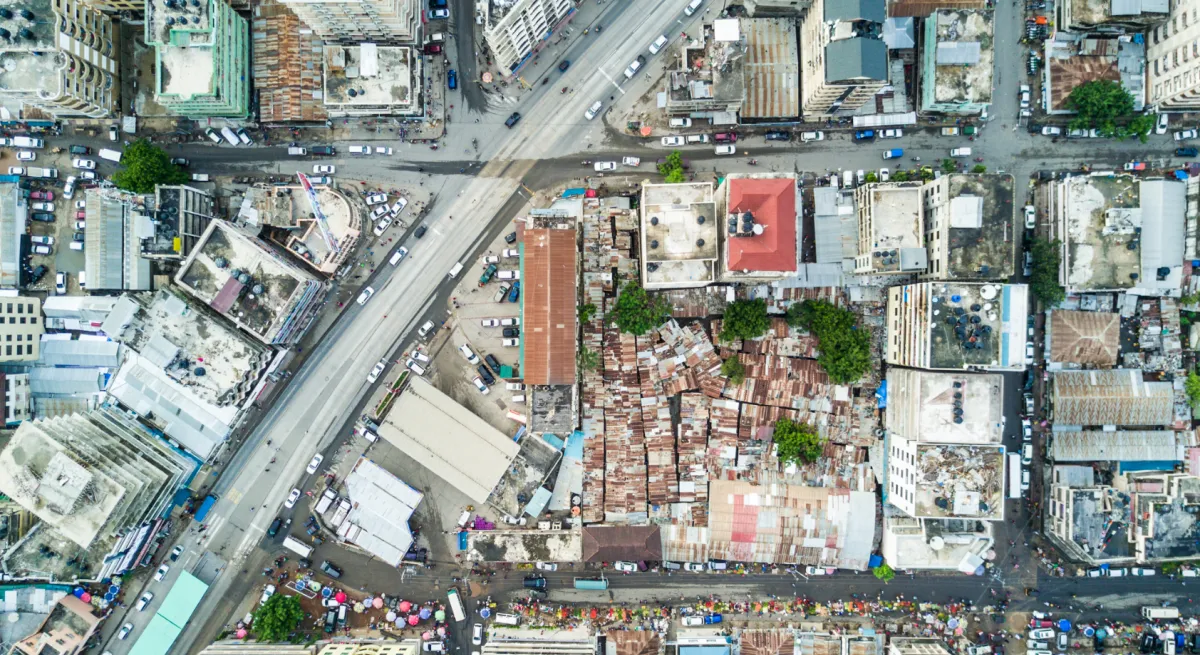
Photo editors have told me there is a unique power in that vertical view. It strips away distraction, reduces complexity, and reveals structure, pattern, and separation.
In that sense, this perspective—seeing inequality laid bare directly from above—was made possible only by the drone.

What does the aerial perspective reveal that other viewpoints cannot?
The ability to look directly downward is incredibly important. Before drones, aerial photographs were typically taken from helicopters or aeroplanes, making it nearly impossible to capture a landscape from a truly vertical perspective. The drone changed that.
Many photo editors have told me there is something uniquely powerful about viewing the world straight down. It eliminates distractions and reduces a city to its essential structures and boundaries. From this vantage point, patterns of separation—often invisible at street level—become strikingly apparent.This perspective lies at the heart of Unequal Scenes. In many ways, the drone made the project possible.
Johnny, what have you observed about the liminal spaces that spatially exist between the rich and poor communities? What qualities do you see from the air?
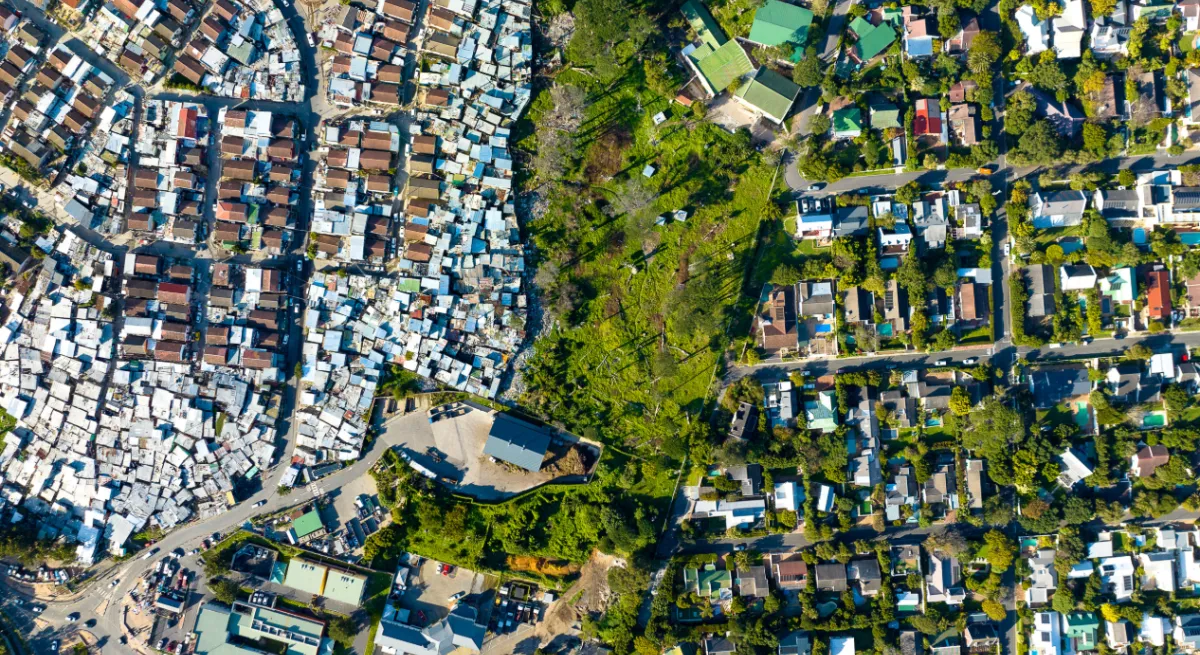
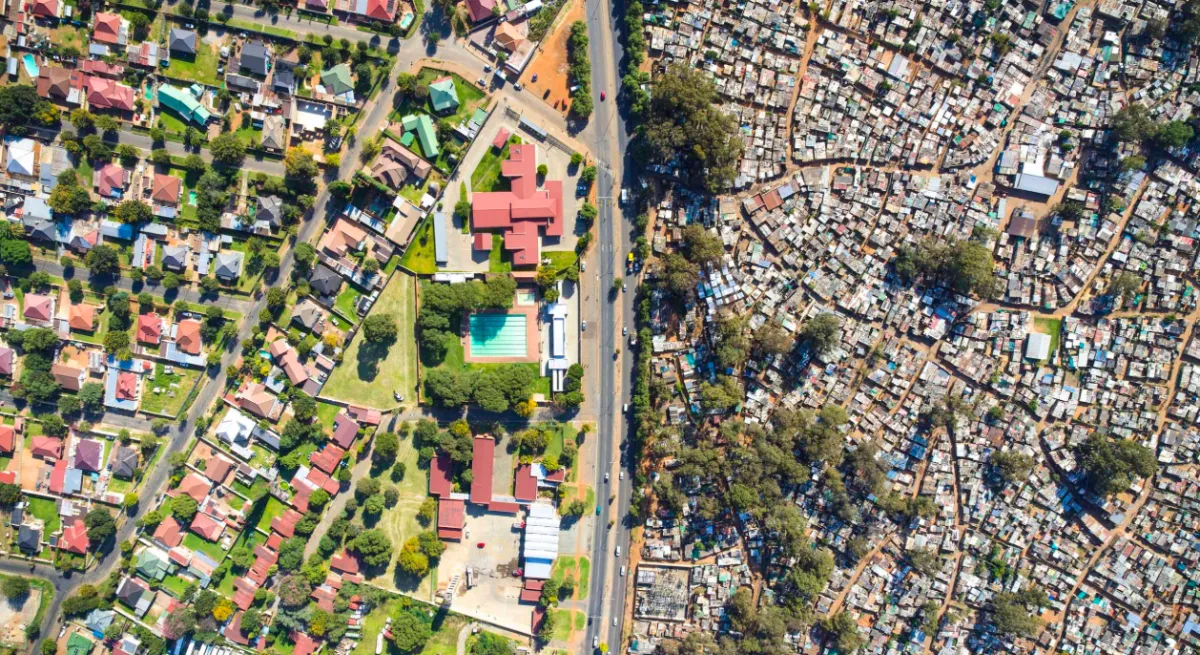
Sometimes that liminal space is large and empty. Sometimes it is only a fence, a hedge, or a narrow road. But in Cape Town I realised that many of those boundaries were not accidental. They had been planned.
Through my research, I found that apartheid-era planners deliberately designed cities to keep people apart. Entrances, roads, bridges, and geographical features all played a role in maintaining separation.
What fascinated me was that similar patterns appear all over the world.
People often argue that communities remain separate because individuals choose to stay apart. My response is to look at the physical infrastructure. Look at the roads. Look at the entrances. Look at the way neighbourhoods connect—or fail to connect—to one another.
People often argue that communities remain separate because individuals choose to stay apart. My response is to look at the physical infrastructure. Look at the roads. Look at the entrances. Look at the way neighbourhoods connect—or fail to connect—to one another.
Take Pinelands and Langa in Cape Town. One was designed as a white suburb inspired by the English garden city movement; the other was a Black township. They sit close together geographically, yet their connectivity is remarkably limited.
I have seen similar patterns in India, Brazil, Kenya, and many other countries.
To me, the photographs function as a form of evidence. They are artworks, but they are also a form of data collection. They reveal how architecture, planning, and infrastructure shape social outcomes over long periods of time.
What I hope the project does is initiate conversations about these systems.
The images resemble maps, yet they are not maps. They are photographs made by a person who deliberately sought out these spaces, researched their histories, and tried to understand what they reveal.
That human element matters. People respond differently when they know there is a person behind the image rather than an automated satellite view.


Your art, your photographs have elicited global attention to the theme of inequalities. Is there a story of transformation in one of the communities, that has been a result of your work or your photos exposing these inequalities?
I try to expose inequalities primarily to show the systemic nature of how inequality works around the world.
There are many people doing important work to reduce those inequalities—politicians, NGOs, governments, activists, and community organisations.
At the same time, many of the places I photograph continue to look remarkably similar years later.
I’m thinking of Masiphumelele in Cape Town, where I took one of my earliest images. Over time, I’ve watched the settlement expand toward the electric fence of the neighbouring affluent community, Lake Michelle.

I often find myself wondering: what happens when it finally reaches the fence? It feels like watching a slow-motion disaster.
A few years ago there was a major fire. Afterwards, the city introduced more organised housing.
People received addresses, electricity, and services—but many remained trapped in places that were never chosen because they were desirable.
One experience that deeply influenced me came after a photograph of Johannesburg appeared on the cover of Time magazine under the headline The World’s Most Unequal Country.
A professor from the University of the Witwatersrand contacted me and challenged me. She argued that images like mine could unintentionally reinforce attempts to remove informal settlements rather than solve the structural problems behind them.That conversation forced me to think more deeply about my role.
I’m not qualified to offer policy solutions. What I can do is document what these systems look like from above and encourage broader conversation.
After photographing 38 cities across 17 countries, one thing has become increasingly clear: the similarities are too consistent to be accidental. This is fundamentally a systemic issue.
What responsibilities do artists have when engaging with inequality?
There’s a difference between an artist’s responsibility and a journalist’s responsibility—and this project sits somewhere between the two. When I first started Unequal Scenes, I described it as an objective view of inequality.
Someone from the Nelson Mandela Foundation challenged that idea. He told me the project would be much more powerful if I stopped pretending it was objective and instead acknowledged that it was my vision of inequality.
That conversation was incredibly important. Once you recognise that a project carries your own perspective, people can engage with it differently.
For me, one of the fundamental responsibilities of both artists and journalists is speaking truth to power. Artists also have the opportunity to create a vision that helps people navigate complex topics.
History is full of examples of artists working on subjects that seemed controversial or unrealistic at the time, only for those works to become enormously important later. One thing I learned is that following your own vision can be uncomfortable.
In the early stages, I tried to distance myself from the project. I wanted it to feel neutral, almost like Google Maps.
Eventually, I realised I needed to put more of my own voice into the work. In that sense, the project gradually became less journalism and more art.

What new directions are you exploring in your work?
One area that excites me enormously is collaboration with neuroscientists and brain-health researchers.
They are studying what is known as the exposome: the accumulated impact of environmental factors such as pollution, economic hardship, lack of green space, and limited access to resources.
Some researchers are conducting fMRI studies in communities similar to places I have photographed. Their findings increasingly suggest that prolonged exposure to environmental disadvantage contributes to what they describe as a “brain age gap.”
My work has evolved from documenting these environments to helping identify and contextualise them for research purposes.
We’ve also been developing a platform called Unequal World.
The idea is to create something similar to Google Earth, where users can explore cities around the world and visualise data related to inequality, environmental exposure, and brain health.
What matters most to me is combining data with storytelling.
The images provide one layer, but equally important are the voices of the people who live in these places and the research being conducted alongside them.
The future of cities will depend on combining technological innovation with genuine community participation.
What advice would you give to young artists working on inequality, social justice, or environmental issues?
One lesson I’ve learned is the importance of defining the boundaries of your project.
We live in a crowded information landscape. If you want your work to have impact, people need to understand clearly what the project is and what distinguishes it from everything else.
For me, Unequal Scenes has very specific parameters: aerial photography, shot directly from above, with a visible boundary in the frame. If those elements aren’t present, it isn’t an Unequal Scenes photograph.
Over the years I’ve experimented with portraits, oblique aerial views, and photographs without visible divisions. Some were good images, but they didn’t belong to the project.
At the moment, I’m speaking with a publisher in Berlin about a book version of Unequal Scenes. Understanding the boundaries of a project allows others to grasp the vision as clearly as you do.
Too often, artists dilute their work by trying to make it everything at once.
For me, socially engaged photography has always been about more than aesthetics. My academic background was in political science and anthropology—not photography.
I wasn’t interested in image-making purely for its own sake. I was interested in using images to reveal underlying issues.
That remains at the heart of what I do today.
Whether the medium is photography, data visualisation, virtual reality, or augmented reality matters less than the ability to communicate an idea effectively and inspire engagement.
The goal is always to help people understand an issue and perhaps encourage some form of action.
What would a more equal world look like to you?
That’s a great question.
I believe in the principles of the Enlightenment: the idea that people should have the freedom to choose their own path through life, express themselves freely, practise their beliefs, and pursue the lives they want to live.
For me, equality is closely connected to freedom and opportunity.
A more equal world would be one in which those principles are more fully reflected in political systems, constitutions, and public institutions.
People should be empowered to make their own choices rather than being constrained by inherited circumstances or social pressures.
At the same time, I don’t think equality can be reduced solely to architecture or urban planning.
I’ve met people living in townships who were remarkably free, fulfilled, and happy. I’ve also met people living in affluent neighbourhoods who felt isolated or unable to express who they truly were.
So while economic equality matters enormously, the deeper question concerns the values through which societies are organised.
I’m increasingly concerned about trends that limit individual agency or concentrate power.
Economic systems should support people’s ability to pursue their ambitions rather than exploit them or make them redundant.
Technology should expand opportunities rather than restrict them.
To me, a more equal society combines freedom, dignity, and economic empowerment.
It’s also important to recognise the people doing the work on the ground. As a photographer, I observe these issues from above. But the people who inspire me most are often activists, lawyers, organisers, environmental advocates, public servants, and countless others working directly within communities.
I have enormous respect for those people.
We should do everything we can to support those working on the ground—while also supporting those who help communicate what is happening from above.

Johnny is a photographer, filmmaker, artist, and drone journalist based in South Africa and the United States. His work explores urbanism, inequality, health, and the built environment through visual storytelling, using tools ranging from aerial photography and satellite data to AI-driven platforms.
His work has appeared in National Geographic, Time Magazine, The Guardian, and numerous books, reports, and films. He collaborates with leading research institutions, including the Max Planck Institute for Human Development, and has exhibited his acclaimed project Unequal Scenes internationally.
Johnny is a Senior Fellow at Code for Africa, an Atlantic Fellow at the London School of Economics, and a BMW Responsible Leader. He is also co-founder of africanDRONE and director of Millefoto, a studio focused on photography, film, and visual storytelling.