Image
The Global Justice Report makes a striking claim: a world where everyone enjoys a decent standard of living, while keeping global warming within safe limits, is still within reach. But achieving it would require a transformation of the global economy on a scale few policymakers are willing to contemplate.
Develop by researchers at the World Inequality Lab and the Global Justice Project, the report argues the climate action, economics justice and inequality should no longer be treated as separate challenges. Instead, they must be addressed as part of the same global project.
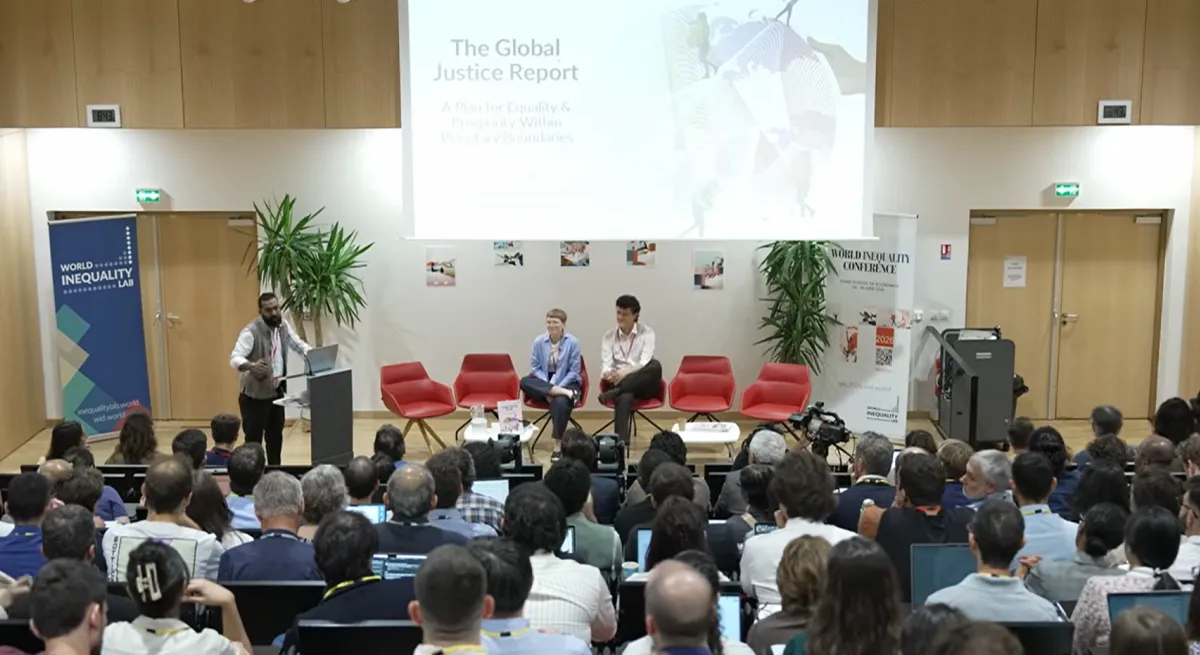
The report was launched and presented in Paris on 4 and 6 June 2026, where Dr Naveen Shamsudhin, Head of the Wealth Inequality Initiative, attended the events to engage with the report’s findings and the broader discussions on global justice and inequality.
Anmol Somanchi, researcher at the World Inequality Lab and the coordinator of the Global Justice Project, spoke with Dr Naveen Shamsudhin about the ideas behind the report, why "sufficiency" has become its most controversial proposal, and what a fairer future might look like.
Naveen: Could you briefly explain what the Global Justice Report is?
The Global Justice Project is a collective research programme consisting of more than forty-five researchers, who have recently released the Global Justice Report, which builds on the work of over 200 researchers around the world who have contributed, in one way or another, to what we call the World Inequality Database.
For almost twenty years, the World Inequality Lab has been looking into the past, asking how income and wealth inequality have evolved at the world level and at the country level over the last one or two centuries. Over time, we felt a need to start looking into the future too, particularly at a time of what some people call a "poly-crisis," with environmental, economic, and political-legitimacy challenges all at once.
So, we thought it was time to bring a forward-looking perspective, starting with a fairly straightforward question: is it possible for all countries in the world to achieve levels of prosperity comparable to, say, the United States, while making sure the planet doesn't burn? We're already at around 1.4–1.5 degrees of global warming relative to pre-industrial levels, and there's a general consensus that anything above two degrees puts us in fairly troublesome territory. That was the central question at the heart of the report.
Part of the motivation was already present in Thomas Piketty's book A Brief History of Equality, where he argues that even though there are large-scale inequalities at the global level, if you take a long-term perspective, things have actually been improving across several dimensions. But it's time we think through a clearer systems perspective on the future, particularly because we're being fed fairly dystopian futures by many people, including some billionaires who talk about colonising Mars or building bunkers at the North and South Poles. We're not sure that's the future the ninety-nine percent want. So, what exactly is a desirable future that we all want? That's what's at the heart of the report.
What we find, and it's a positive message, is that it is possible to combine shared prosperity for all with planetary habitability, but only if we transform the global system along three key dimensions.
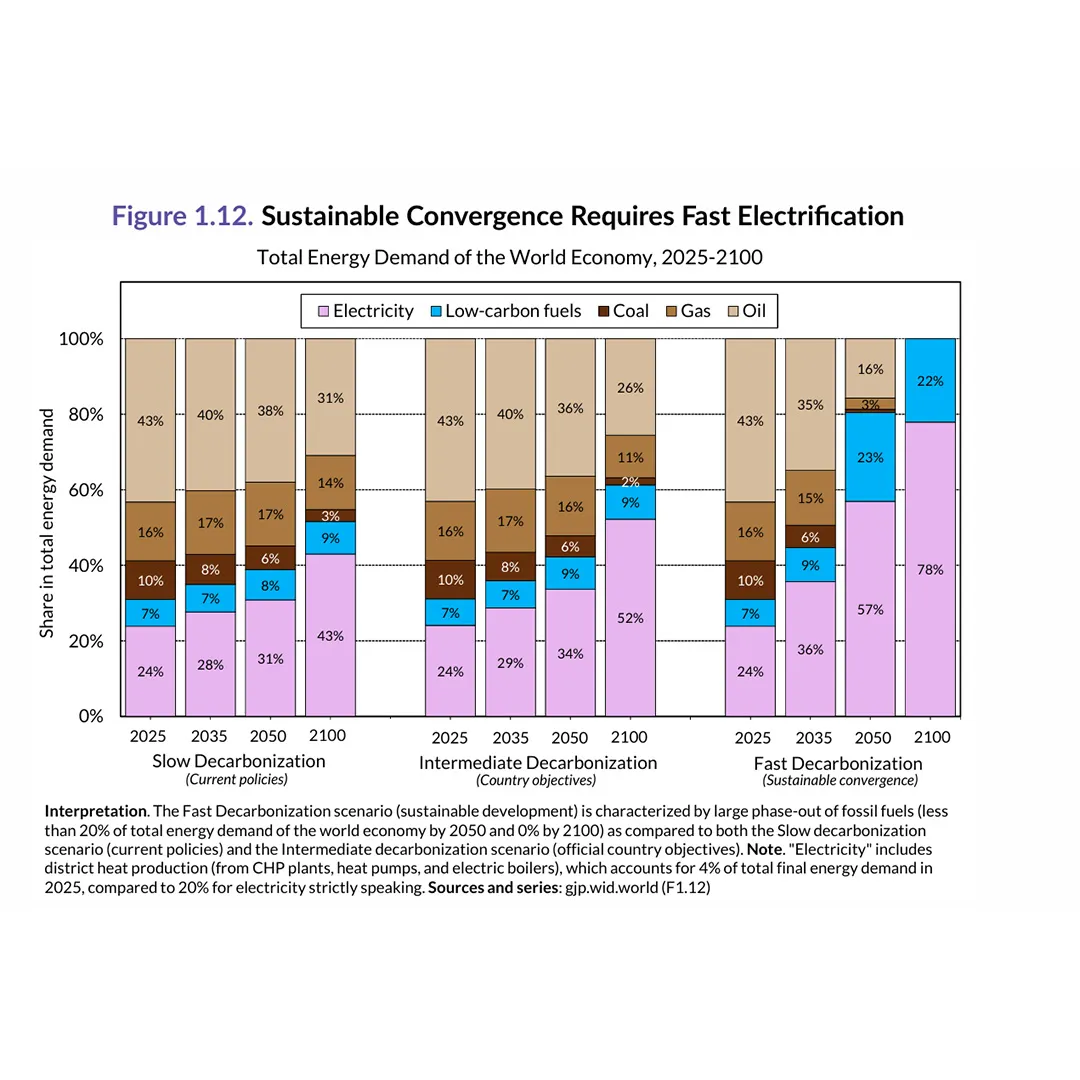
We need to phase out fossil fuels as soon as possible. By 2050, a large share of that should be done, and by the end of the century we should be using zero fossil fuels, alongside a shift towards electrification of energy systems.
The second, arguably more controversial, element is what we call "sufficiency", the argument that today's rich countries have already consumed more than their fair share of the carbon budget. The first part of sufficiency is some form of growth cap in very rich countries: once they reach around 5,000 euros a month in per-capita income, growth there should slow, driven by a reduction in working hours rather than a fall in productivity. The second part involves changing food habits, because grazing land is one of the biggest drivers of forest-cover loss, restoring forest cover to roughly 1900s levels would require a significant reduction in red-meat consumption across Europe and North America.
The last pillar is a sharp reduction of inequality within countries. This is especially important for the Global North: if average incomes stop growing much, the only way people at the bottom of the distribution can keep seeing income growth is through redistribution from the top.
Is it possible for all countries in the world to achieve levels of prosperity comparable to, say, the United States, while making sure the planet doesn't burn?
Of the three pillars you mentioned that sufficiency is perhaps more controversial than economic compression. I would have assumed the tax reforms - the wealth tax, would attract the most criticism.
Yes, indeed. Sufficiency is the most controversial element of our report, and the one that's drawn the sharpest criticism. Increasingly, even among economists, some degree of wealth taxation — a coordinated global wealth tax, is something many see the sense in. For the general public. What's more controversial, particularly among economists, is a kind of sacralisation of growth: the idea that growth is the be-all and end-all of progress. So when we argue for growth caps in rich countries, that doesn't sit well with a lot of people.
There was an article a couple of weeks ago in the Financial Times that dismissed the Global Justice Report as an agenda for so-called "degrowth. "It's true that we argue for a fairly low growth rate, between zero and 0.5 per cent a year, in rich countries, but we argue for extremely rapid growth in the rest of the world, which is the majority of the world." There's a finite carbon budget, and lower- and middle-income countries need to grow; rich countries now owe them the duty to create the carbon space for that growth. So dismissing the report as "degrowth" is a bit of a distraction, actually, it's mainly the argument that growth should be limited to some extent in rich countries.
I understand why economists aren't happy, because there are genuinely many benefits of growth, which is exactly why we want poor countries to grow rapidly. But the moment you take a climate-justice perspective, it's hard to ignore historical responsibility. How do you ignore the fact that the wealth, life expectancy, and education systems that children in today's rich countries inherit are, in part, a result of past emissions? When we make this argument, people sometimes say, "fine, nice woke argument, but why should today's generations pay for their ancestors' actions?" Well, they're benefiting from those actions in many ways.
There are also critics who think we're being too optimistic, that we're saying all this growth can happen while staying within 1.8 degrees, but that this ignores other planetary boundaries beyond the carbon budget: oceans, glaciers, Arctic ice, and the very real hard limits on how much we can keep extracting from natural resources. I find that second type of criticism slightly more convincing, it's true we could be too optimistic, and that's something we intend to work on in future work.
It's interesting to me that the report is titled Global Justice Report, it could have been a "global vision report" or something else. How did the World Inequality Lab arrive at this framing, that justice is at the centre?
This project began almost two years ago. We wrote seven technical papers covering different elements that form the technical backbone of the report. From the start, it was clear to us that issues of climate justice cannot be disentangled from issues of economic justice.
The moment you realise that contributions to global warming are highly concentrated among rich countries, while the costs of global warming are highly concentrated among poor countries, which tend to be in tropical climates, have worse health conditions, and poorer resilience and adaptation capacity, it becomes clear that what we want to think about is what a fair and just economic and climate system would look like. So we started by asking: what is a just and fair society? In the report's introduction, we say it's a society where everyone is treated as free and equal, and everyone has access to the most basic fundamental goods of life, health, education, political participation, all of which are inseparable from the climate question. That's where the question of justice comes in.
Whether what we deliver in the report is truly justice is debatable. Some have rightly criticised us for not being radical enough. We've tried to put forward a universalist perspective, for instance, the Global Justice Fund is meant to distribute country dividends on an equal per-capita basis: every global citizen would receive exactly the same amount. But some would argue that if you really want justice, transfers should be targeted at countries that have historically faced the strongest colonial damage and are most likely to face climate challenges. So whether we fully deliver justice is debatable, but justice was certainly at the heart of what we tried to do.
It's true that we argue for a fairly low growth rate, between zero and 0.5 per cent a year, in rich countries, but we argue for extremely rapid growth in the rest of the world, which is the majority of the world.
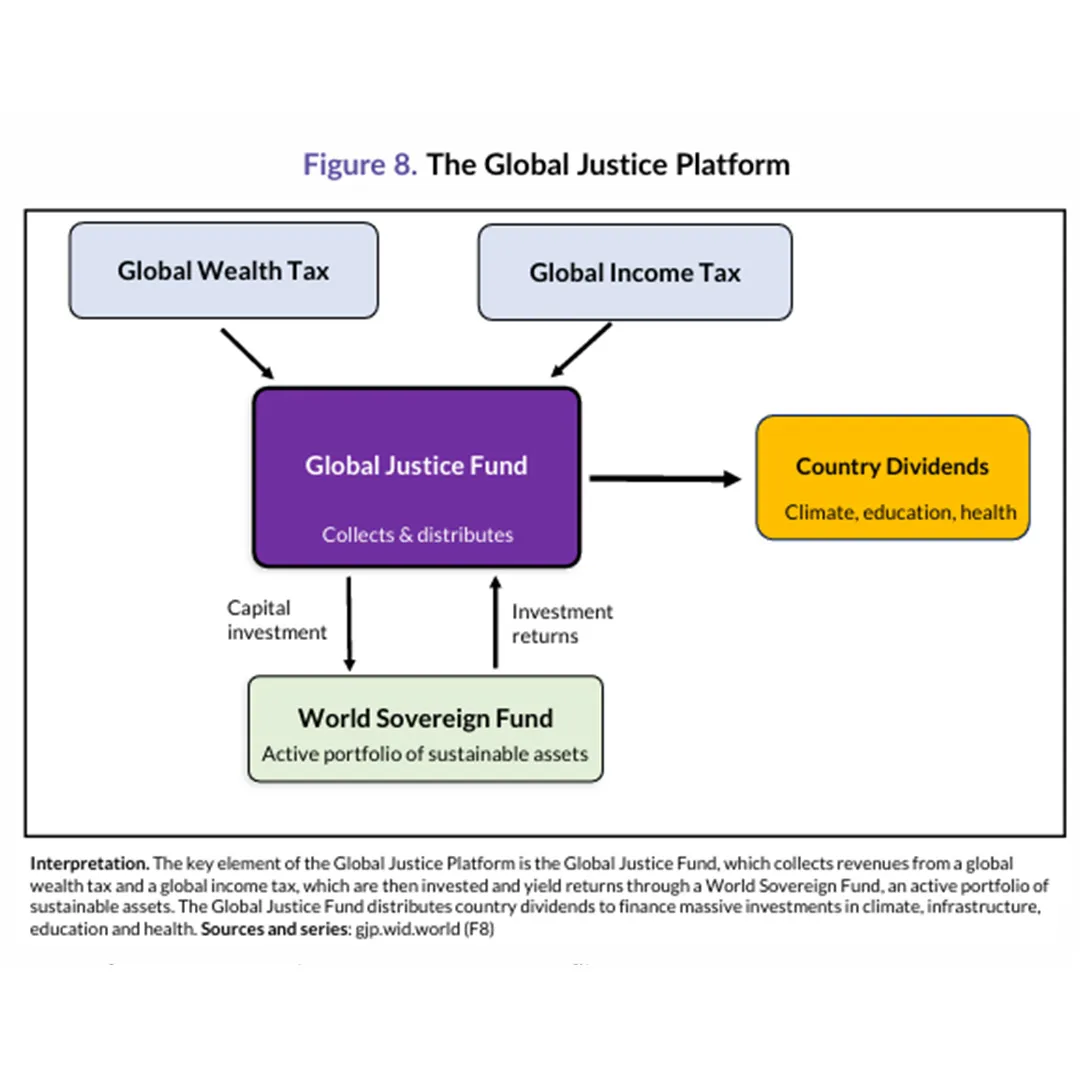
You also put forward a "Global Justice Platform." Could you explain what the platform is, what the framework is, and add some of the numbers involved in each subcomponent?
The basic idea is that this vision for the twenty-first century will have to come through global, supranational coordination among countries and organisations, that's what we call the Global Justice Platform. The main architecture revolves around two big elements. First, we propose establishing a new organisation called the Global Justice Fund, a bit like the International Monetary Fund, but arguably much more democratic. Its main job would be to raise and administer the large sums of finance needed to implement the plan, in particular to invest in the energy transition, especially in developing countries that don't have the means to do it fully on their own.
To raise that money, we argue for a global wealth tax. It's fairly radical proposal: for individual with more than €50 million in wealth, we propose a 20% wealth tax. At that rate, within five to seven years there would basically be nobody left in that very high wealth bracket, and that's partly by design, because we think that level of concentration is neither economically just nor politically sustainable. Combined with a global income tax, both applying based on a person's income or wealth level, regardless of country of residence, we intend to raise around 10% of world GDP annually.
And how much is that 10% of world GDP, in absolute terms? And how many people would the taxation affect, in numbers?
Almost €15 trillion, which is an enormous sum of money, and it would affect fewer than 1.5 per cent of the world's population. We were ourselves surprised by how small that number is. Even after taxation, these people would still be among the wealthiest in the world. For comparison, India's National Rural Employment Guarantee Act, a fairly radical rural-employment programme, costs about one-tenth of one percent of that amount.
Part of that revenue is intended to go towards another new institution we propose: the World Sovereign Fund, inspired by sovereign funds like Norway's and the UAE's. We would accumulate a stock of sustainable assets; after around ten years, the fund would be large enough to generate substantial investment returns. Once that happens, we would no longer need to rely on wealth and income taxes, almost all the country dividends we want to distribute would come from the sovereign fund's returns.
Is it accurate to understand that the taxation is a temporary measure?
The wealth tax is certainly temporary, because if implemented as designed, there won't be anyone left in those wealth brackets to pay it. The income tax would also come to raise a very tiny share by 2050–2060, less than 0.5%, with the rest coming from the sovereign fund. I want to clarify that this global wealth and income tax is in addition to country-level taxation; what countries do on their own to raise revenue is completely separate.
The idea is that every citizen of the world would get roughly 1,200 euros a year in country dividends. In some rich countries that might seem negligible, but for a country like India, that's five to six times what the average person earns. At least half of that 1,200 should go towards climate investments, both mitigation and adaptation. The remaining half, about 600, could be divided between health and education spending, both of which contribute to human-capital development.
In the context of this vision, were you the first group to actually bring the social, economic, and climate dimensions together?
At least in the recent literature, we're the first to bring inequality and climate into the same picture. The Intergovernmental Panel on Climate Change (IPCC) does very similar scenario modelling, that part isn't new. But one criticism the IPCC has faced, including from countries like India, is that even in its most ambitious sustainability scenarios, there's still a large gap between Sub-Saharan Africa and North America by the end of the century, the distributional aspect is largely ignored. IPCC scenarios also tend to treat the aggregate economy simply as total GDP, missing the fact that the sectoral composition of growth matters both for carbon footprint and for actual welfare.
So I believe we're the first to combine full income convergence with the two-degree climate target and to spell out what's required to achieve both, and the first to take a disaggregated, sectoral view of the economy as an explicit lever for reducing carbon footprint. We're also among the first to discuss reform of the international financial order alongside these issues. The report argues it's important to move beyond "classless ecology", the idea that climate problems can be solved without tackling inequality, which we think is misguided, and one of the reasons the average citizenry isn't more supportive of sustainable policy. The Yellow Vests movement in France, and similar movements elsewhere, arose because the burden of climate policy was placed on the poorest, without addressing the private jets and luxury yachts of the wealthy.
When I first read about the idea of everyone in the world receiving €5,000 a month, I thought that's visionary. What does a world in the year 2100 look like, according to the Global Justice vision?
That's a very good question, and maybe one of our weaknesses is that we laid out very technical aspects but didn't do enough to describe what that world actually looks like. One idea running through the report is what it means to have a good life. One version is: I have two Ferraris, four iPhones, everything at the push of a button. Another version is: I have twice the free time, I can spend much more time with my children and family, I have education and health systems comparable to the best in the world, I have a monthly income of €5,000, and I have a planet that isn't burning.
Part of what it will take to reach 2100 is an intellectual and cultural shift in how we think about a good life. There's nothing wrong with material consumption per se, in fact, in countries like India, we urgently need it to rise. But is that the be-all and end-all of a good life? Or are there other things that tend to get ignored, the fact that we spend five days a week working and then celebrate that the weekend has arrived?
By 2100 there might be some "Jetsons"-type elements, such as flying vehicles, but the fact that we'd work half as much, have more than double the income, have high-quality, accessible healthcare for all and have a more robust care economy for our parents, our children and ourselves is, we think, more important to a good life than, say, a third iPhone. It's about things like playing more football and not spending all our leisure time flying between islands and burning ever more fossil fuel. If we use our leisure time to give music lessons or play football, that's fantastic. If we use it to fly from one island to another, that's probably not what we have in mind.
To move the vision of the Global Justice Report into action, who should be in the room next? If you were to design the ideal gathering, who should be in it?
My answer might sound clichéd, but I assure you it's what we mean: this is a battle that needs to start from the most local level, city-level organisations, political organisations, groups of citizens, all the way up to supranational global coordination. Some things, like convincing people that sufficiency is worth the cost, can only happen through dialogue; we're not authoritarian thinkers, so we don't want anything imposed by force Unions, local leaders, citizen groups and reading clubs; everyone needs a say. We certainly don't think we have the final answer; this is one possible vision, as long as we all agree on the goals: shared prosperity and planetary habitability.
We're not naive enough to think there will be full agreement; building consensus will be very difficult. We recently found a YouTube video of a group of 75–80-year-olds who had read the report and were discussing it among themselves, I found that heartening, since we assumed this would appeal much more to younger generations.
The role of progressive governments will also be crucial. With India, Brazil, China, and other countries taking a more progressive stance, it will be harder for Europe and North America to keep ignoring these concerns. The US is already losing its hegemonic economic control over the global economy; there will be no single hegemonic economic power by the middle or end of the century. There's an upcoming UN Tax Convention that will discuss changes to the international tax code, and the G77 group of lower- and middle-income countries is already pushing back against the unanimity principle rich countries use to block progressive measures. We don't want to be in a position where, once things have gone too far, we're left asking "what's the alternative?" It's much better to start working on that alternative now.
Would you say there's been a first "win" for you all since the report was published?
I wouldn't say that yet, it would be premature. Until the conference and the report launch, we were just racing against time to get the academic work in place There have been some encouraging developments, although I would not call them wins just yet. We were invited to speak at an all-party meeting in the Spanish Parliament, multiple political parties in Germany have expressed interest in discussing our work, and the Chair of the UK Green Party has said that they have spent considerable time thinking about the report. So, it's already generated some interest, but I think it would be unfair to call any of it a "win" just yet, I'm hoping for one soon.
So, what are the next steps for the Global Justice Project?
There are a few academic steps, elements of the underlying model that can be updated. We're trying to incorporate other planetary boundaries where we can, and to expand the kind of data we incorporate, including material extraction at the sectoral level, which we didn't have time for in the main report. Right now, we meet every week to discuss our outreach plan.
At this stage, we're mostly focused on outreach. There have been discussions about releasing an update every two or three years, though we're not sure yet. We're also in the process of raising more funds to expand the project, applying for ERC grants and others. So, we're first focused on getting the message out as far and wide as possible, while knowing that, once things settle, there's more academic work ahead.
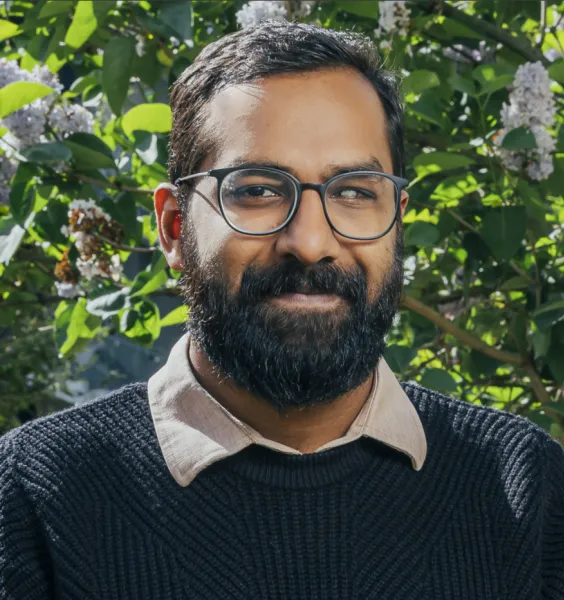
Anmol Somanchi is Global Justice Coordinator at the World Inequality Lab and a PhD researcher at the Paris School of Economics. His work explores the structural drivers of economic inequality, drawing on expertise in labour markets, social protection and development economics. Through his research and advocacy, he contributes to advancing the global conversation on economic justice and more equitable pathways to development. His previous experience includes roles at IDinsight, Research for Action, the Indian Institute of Management Ahmedabad and Sociometrik.